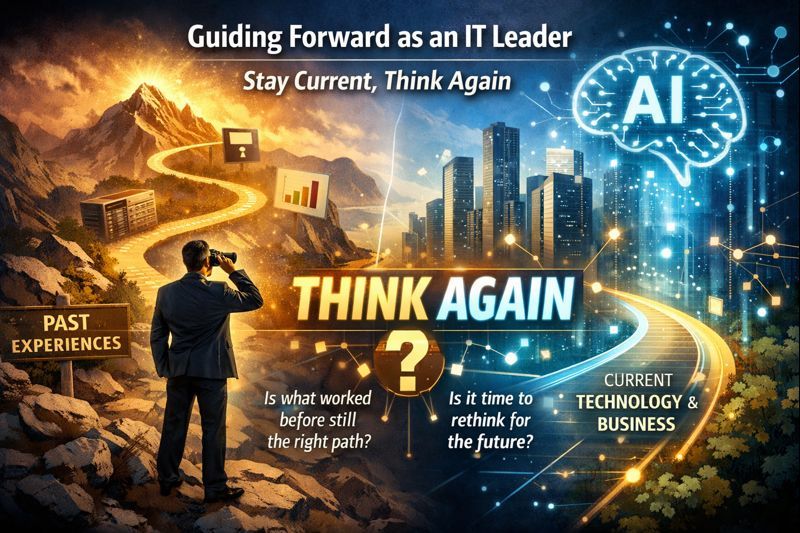
One thing I learned as a CIO that has stayed with me through every role since: lead with experience, and defend it confidently. But only when you're sure it is still relevant.
Your experience is one of your greatest assets. It gives you pattern recognition, judgment under pressure, and the credibility to lead through uncertainty. But it's only as good as your ability to keep it current. Not just current with technology — current with your business, your industry, and the environment you're actually operating in today.
The Question I Learned to Ask Myself
When I got pushback on an idea from a peer, a board member, or a functional leader I found it useful to stop and ask myself something before doubling down: What has changed since I learned what is telling me this is a good idea?
Am I drawing on a principle validated by demonstrated success that still holds in the current environment? Or am I excited about something because of a past experience that may no longer be relevant?
That's a harder question than it sounds when you're in the middle of making a case for something you believe in. But it's the right question.
The Bleeding Edge and the Weight of Legacy
I've felt both sides of this personally. I've been on the bleeding edge of new technology and the scars to prpove it. I've experienced the anxiety and pain of inherited technical debt. Legacy IT is rarely appreciated by those who inherit it. Yet a full transformation almost never comes without serious risks and crapload of hard work..
What I kept reminding myself is that perfect happens only in dreams. My experience is lived in reality, with real tradeoffs, real constraints, and real consequences.
Keeping current isn't just about reading industry reports or attending conferences. It's about observing and watching how technology actually lands in organizations. How employees respond, how customers are affected, and how suppliers adapt. You need to be being willing to adjust your thinking based on what you see and what your learn.
The GE Translation Problem
Leadership was fundamental to everything we did at GE. It was deeply embedded in the culture and genuinely effective. But not everything I learned there translated directly to other companies and industries. Much of it required significant adaptation to make it work before it could be applied. Some of it needed to be set aside entirely while gritting my teeth.
It's a bit like a NASCAR driver getting behind the wheel right after a race and trying to navigate normal city traffic. The skills are real. The experience is genuine. But the context has changed enough that direct application can actually make things worse, not better.
My point, and yes, I'm getting to it, is that experience is a necessary guide, but it is not sufficient for leading effectively in a rapidly changing environment. The CIOs and CTOs I've seen succeed consistently aren't just the ones staying current with technology. They're the ones continuously learning and adapting to the changes affecting their specific business. They are the ones willing to question their own assumptions when environments shift.
Think Again
Adam Grant makes a compelling case in Think Again that rethinking and unlearning are among the most important skills in a rapidly changing world. It's not a comfortable message for people who have spent decades building expertise. But it's an honest one, and one that will prove helpful to your career.
The questions worth asking yourself regularly:
What is different now than what my experience is telling me? Is there a translation needed before I apply what I know? Has the entire game changed since the approach I'm drawing on actually worked?
AI is not a small change in how technology gets things done. It's a genuine shift in the rules of the game of how work gets done, how decisions get made, and what competitive advantage actually looks like. Treating AI as just another technology cycle is the kind of mistake that experience, without reflection, leads you astray.
Taking a pause to reflect while you learn, even for a type A like me, turns out to be one of the fastest ways to move forward. Slow down a bit to speed up. It works.